
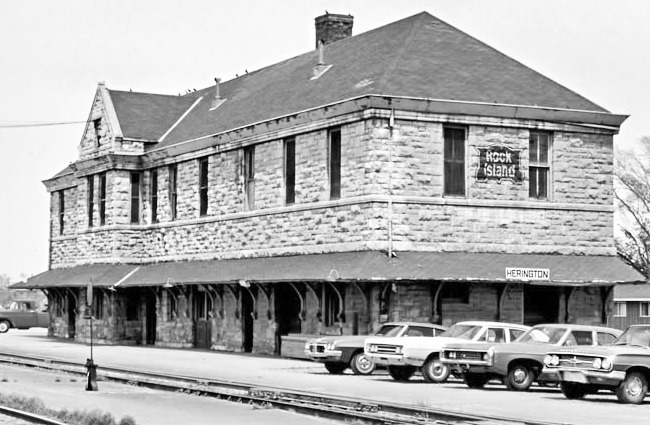
A 101-year-old landmark disappeared on March 23, 1988, before many Herington residents knew demolition had begun For people who grew up in small Kansas towns, neighboring communities could sometimes seem much farther apart than the miles between them. Council Grove and Herington met on athletic fields and courts, and most people in this area knew that Herington was a railroad town. But events in one community did not necessarily become lasting memories in another.
That may help explain why one of the most dramatic episodes in Herington’s history is not widely remembered today. Thirty-eight years ago, on March 23, 1988, residents of Herington went to bed with their 101-year-old Rock Island depot still standing. Before sunrise, it was gone.
A private contractor began tearing into the two-story limestone passenger depot at about 5:40 a.m. According to later accounts based on contemporary preservation records, a large hydraulic backhoe reduced the building to rubble in less than an hour. There had been no advance public announcement that demolition was about to begin.
The depot’s loss was especially significant because Herington’s history and the railroad had been intertwined almost from the community’s beginning.
In 1887, town founder Monroe Davis Herington persuaded the Chicago, Kansas and Nebraska Railroad to build through the community. He provided land and right-of-way, helping secure Herington’s position as a railroad division point with shops, two roundhouses, a freight house, bridge yards, a telegraph office and other facilities. Herington also furnished the limestone for the freight house and the two-story passenger depot. The depot was originally 28 by 66 feet and was later enlarged to 28 by 105 feet.
The building became closely identified with the Chicago, Rock Island & Pacific Railroad and with Herington itself. For generations, the depot was a place of arrivals and departures — a physical reminder of the railroad industry that helped shape the town.
Passenger service eventually ended in the 1960s, but the Rock Island continued using the depot for offices. After the financially troubled Rock Island ceased operations in 1980, the St. Louis Southwestern Railway Co., commonly known as the Cotton Belt and associated with Southern Pacific, acquired the Golden State Route through Herington. The railroad later moved its offices elsewhere in the yard, leaving the old depot vacant.
By the mid-1980s, there was discussion in Herington about preserving the unused building, although no organized local effort had developed to acquire it. At the same time, the depot was receiving formal recogni- (Continued from Page 1) tion for its historical importance.
In April 1987, the Kansas Historic Sites Board of Review announced that the “Old Rock Island Depot” in Herington would be considered for nomination to both the National Register of Historic Places and the Register of Historic Kansas Places. Federal records subsequently identified the Chicago, Rock Island and Pacific Railroad Herington Passenger Depot as having been determined eligible for the National Register on July 28, 1987. The property was on the Kansas register, but the railroad owner’s objection prevented formal National Register listing.
Less than eight months later, the depot was destroyed.
The St. Louis Southwestern Railway had hired the contractor to demolish the building. According to an account published by the Kansas League of Municipalities’
neither the railroad nor its contractor obtained the $5 demolition permit then required by the City of Herington.
That omission was important. Kansas preservation law provided a review process for projects affecting properties on the state or national historic registers. Without a demo-lition-
permit application, the normal
process that could have alerted state and local officials before the building came down was bypassed.
The reaction extended well beyond Herington. Newspapers around Kansas reported on the demolition, and preservationists criticized the manner in which a building that had stood for more than a century could disappear before most residents even knew what was happening.
Virginia Brunner, then curator of the Tri-County Historical Society, summed up the local reaction in comments to the Wichita Eagle-Beacon: “They robbed future generations. They robbed the whole town.”
The incident also reached Topeka. Then-Kansas Attorney General Robert Stephan urged lawmakers to strengthen state preservation law so there would be meaningful consequences when required permits were ignored in the demolition of historic properties. Legislation addressing that issue was approved later in 1988. Kansas statutes continue to give the attorney general authority to pursue civil penalties when a person or entity fails to obtain a required building or demolition permit before damaging or destroying a property on the state or national register. The statute’s legislative history records amendments adopted in 1988.
The depot could not be brought back.
Other pieces of Herington’s old Rock Island complex disappeared as well. The roundhouse and turntable were removed in the weeks following the depot demolition, and the railroad’s old coal tower was also demolished that year.
But Herington did preserve something from the building.
A memorial at the Herington Historical Museum incorporates native limestone and the benchmark from the old depot. Its inscription is simple: “Rock Island Depot — 18871988.” It records the date the building was razed — March 23,1988.
The City of Herington also continues to recognize the depot as part of its history. A mural depicts the stone station that once stood at Walnut and Fifth streets, another reminder of a building that for decades was one of the most recognizable structures in the community.
For those who lived outside Herington, the event may have been another piece of news from another town — noticed briefly and then overtaken by everyday life. For Herington residents, however, March 23, 1988, marked the morning when a building that had stood almost as long as the town itself disappeared in less than an hour.
What remains today is not simply the story of an old railroad depot. It is also a reminder of how quickly a familiar landmark can become history.